Experience / Case studies
Case studies: what KrimaAi has delivered.
One project for each of our three core services: a 32-agent AI team run through one chief of staff, Riparian’s engineering workspace with an AI co-worker built in, and an AI governance program for a life sciences advisory firm. Each one covers the context, the challenge, what we did and the result.
Updated
A 32-agent Grok bot team with one chief of staff
Two companies now run lead generation, outreach, RFP screening, and admin through one agent team, overseen from a single place.
- 32agents
- 1chief of staff
- 2companies served
- 13systems connected
Context
A business owner running two companies wanted AI to take on the work that kept piling up: finding and qualifying leads, outreach, SEO and social campaigns, RFP screening, banking, and day-to-day admin, without adding staff.
Challenge
Dozens of agents with broad access would be impossible to oversee. The owner needed one place to route requests, a clear line between shared company agents and personal ones, and tool access scoped to each role.
What we did
We designed and deployed a 32-agent team on Grok: a chief-of-staff agent that routes everything; outreach agents for CRM, lead generation, cold outreach, SEO, and competitive intelligence; business agents for RFP screening and banking; a bot-ops group that designs new agents and handles phone calls, IT administration, and security; and connections to Outlook, Teams, HubSpot, GitHub, Azure, Plaid, and more.
Result
The team is in daily use across both companies. New agents join through the same routing and access rules, so the team grows without losing oversight.
Outreach6 agents
- RossiCRM and HubSpot owner
- HunterFinds new leads
- LeoCold outreach rep
- ScoutScores and qualifies leads
- SparkMarketing and SEO engine
- BourneCompetitive intelligence
Business Ops4 agents
- KoaKrimaAi assistant
- BanksBusiness banking
- TraderDay-trading analyst
- GrantRFPs: Krima, Riparian, devbot
Media & Creative4 agents
- PsalmPsalmSprout showrunner
- A24Video production director
- PennyPinterest curator
- SallyDJ on Spotify
Bot Ops4 agents
- dr eggbotBot designer
- 9000Phone calls
- RootIT admin
- SkyeSecurity
Personal and household14 more agents across 2 private groups, not shown
- Outlook
- Teams
- OneDrive
- Outlook Calendar
- Gmail
- Google Calendar
- Google Drive
- HubSpot
- X
- GitHub
- Azure
- Bland AI
- Plaid
Riparian: an engineering workspace for hardware teams, with an AI co-worker built in
A live, paid product: hardware teams review boards in the browser with an AI co-worker that never acts outside a user’s permissions.
- Livepaid product
- 2D + 3Din-browser, no plugins
- IPC-2581read natively
- EveryAI edit approved by a person
Context
Riparian is a subscription workspace for small and midsize hardware teams that ship printed circuit boards. It sits around the EDA tool rather than replacing it, and connects design reviews, tasks, bills of materials, documentation, and an AI assistant to the actual board data.
Challenge
Hardware teams run reviews over email and spreadsheets because a full PLM system costs too much. The product had to read IPC-2581 board files natively, render boards in 2D and 3D in the browser with no plugins, and let an AI assistant work on real board data without ever acting outside a user’s permissions.
What we did
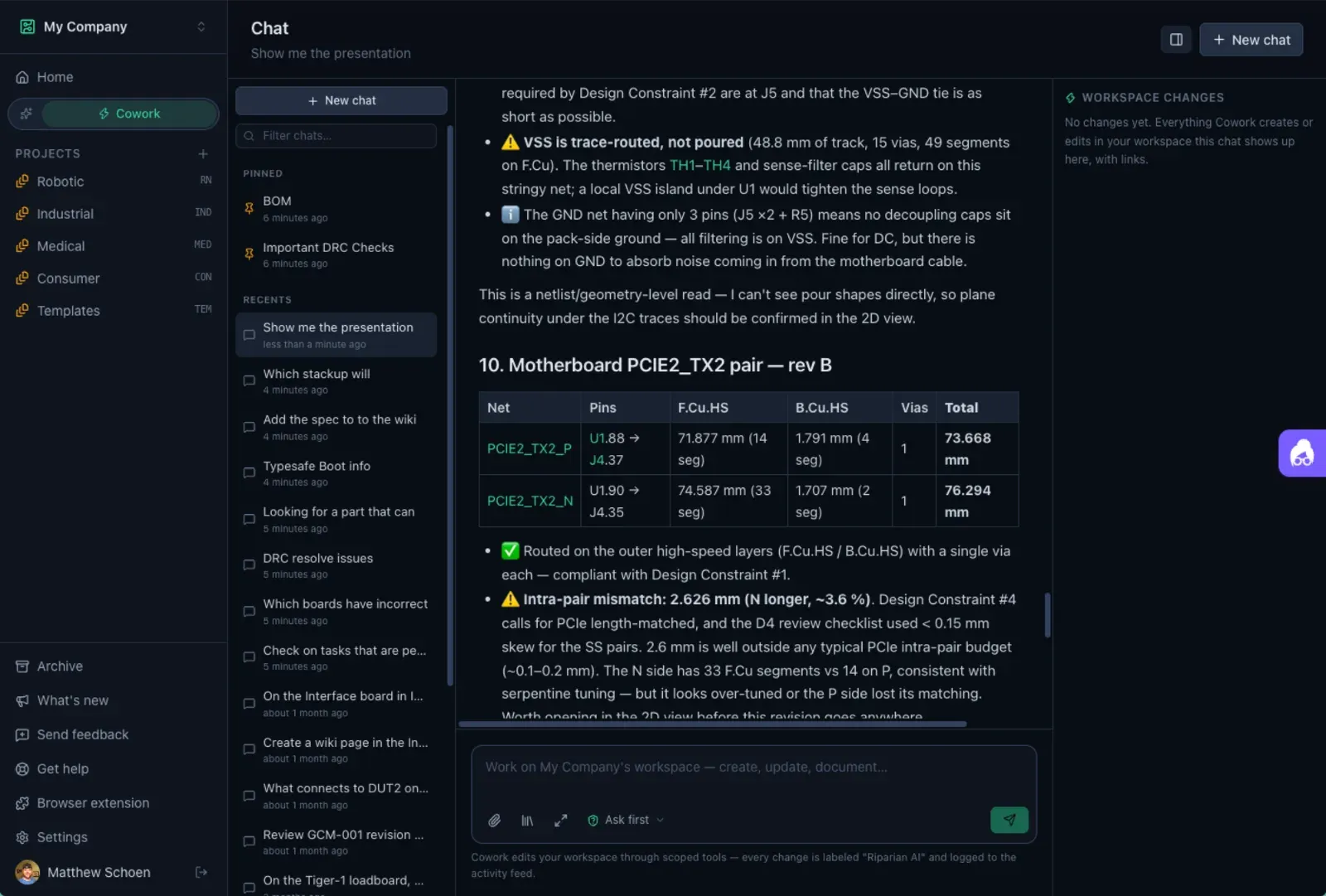
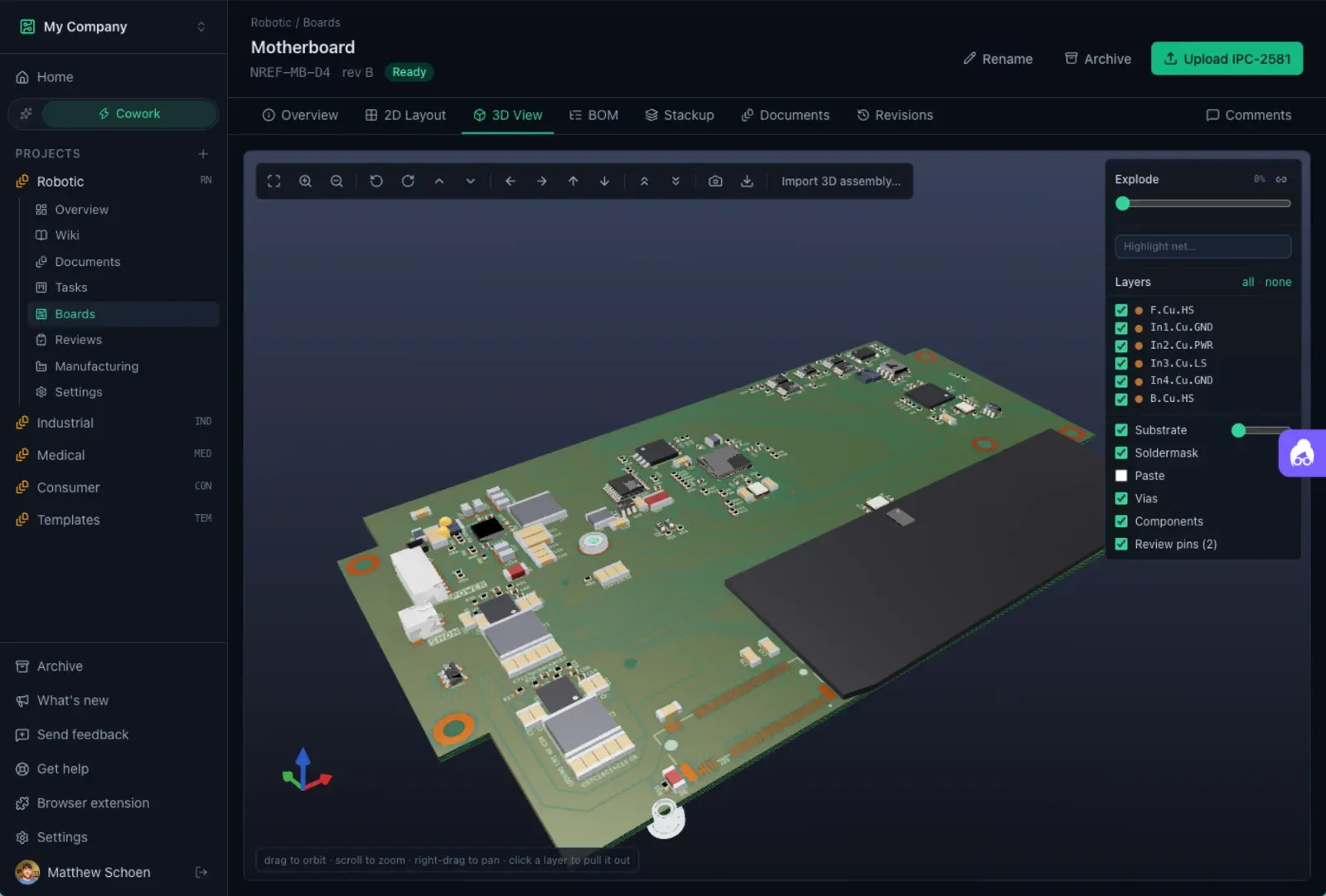
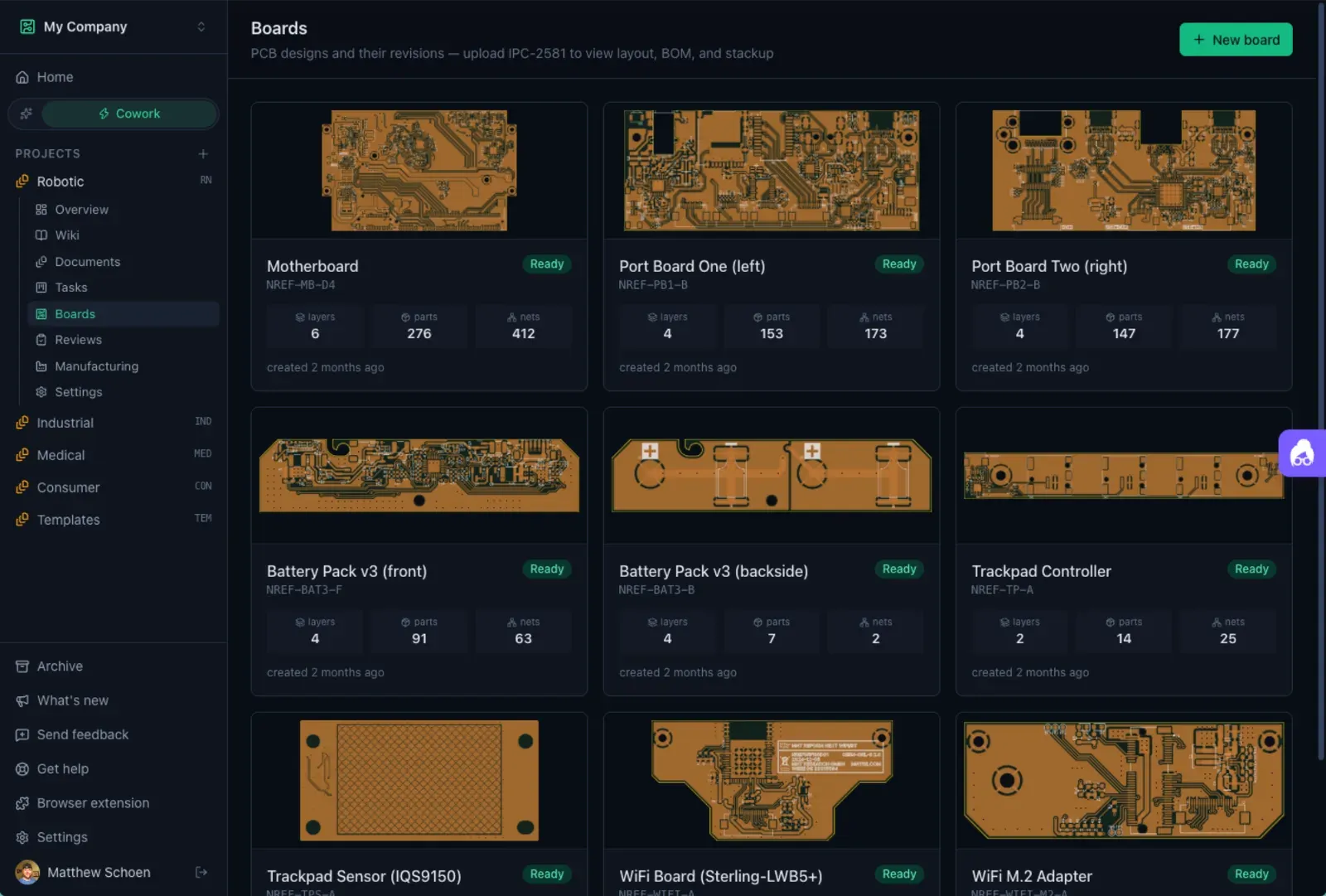
We designed and built the application: in-browser 2D and 3D viewers for IPC-2581 files with layer control and net tracing, design reviews pinned to pads and nets with approvals, a BOM built from board data with a vendor list and diff review, versioned release packages, and Cowork, an LLM assistant that runs design-rule reviews and proposes edits to tasks, BOM lines, and wiki pages. Every AI change is scoped to the user’s permissions, labeled, logged, and approved by a person before it lands.
Result
Riparian is live as a paid product with a free trial, row-level security in the database, private org-scoped storage, two-factor authentication, and AI models that are not trained on customer data.
The screens below are from the product.
An AI governance program for a life sciences advisory firm
The firm can now say where AI is used, what client data it touches, who owns it, and show the evidence when a client asks.
- 1inventory of every AI use
- 5risk areas assessed
- 4policies, each with an owner
- 4controls paired with evidence
Context
BGA is a biotechnology and life sciences advisory firm. Its team provides leadership development, strategic planning, FP&A and M&A diligence, and fractional executive support, which means its advisors handle confidential client material every day.
Challenge
AI assistants and the AI features inside everyday tools were arriving faster than any policy. The firm needed to know where AI was in use, what client data it could touch, who was accountable, and how to answer a client who asked.
What we did
We inventoried every place AI was used or planned, assessed the risks that matter for a firm handling confidential diligence and financial data, and wrote policies with named owners for acceptable use, client data handling, review of AI output, and vendor selection. We closed with a prioritized plan for the controls to put in place and the evidence that shows each one operating.
Result
The firm has an AI policy set its team can operate, a current inventory, and the evidence to answer client questions about how AI touches their work.
- 01Assess
- 02Define
- 03Deliver and verify
01 AI use inventory
| Where AI is used | Data it touches | Owner |
|---|---|---|
| General-purpose assistants | Client and firm material | Named partner |
| AI features in existing vendors | Email, documents, CRM | Operations lead |
| Diligence and FP&A workflows | Financial models, data rooms | Engagement lead |
| Internal automation | Internal records only | Operations lead |
02 Risk assessment
- Confidential client data in third-party tools
- Unreviewed AI output in client deliverables
- Vendor terms and model training on firm data
- Access, retention, and offboarding
- What clients are told about AI use
Each area rated for this firm and prioritized by what reduces the most risk first.
03 Policies and responsibilities
- Acceptable useAll staff
- Client data handlingEngagement leads
- Review and approval of AI outputDeliverable owners
- Vendor and tool selectionOperations lead
Written for the team that uses them and assigned to named roles.
04 Controls and evidence
- Approved tools listTool register with vendor terms
- Client data rules per engagementSigned data handling checklist
- Human review of AI outputReview sign-off in each deliverable
- Changes to vendor AI featuresChange log and re-assessment
Every control paired with the evidence that shows it operating.
Get in touch
Have a project like these? Let’s see if we’re a good fit.
Tell us about the problem, the scope you have in mind, and your timing. If you are sending an RFP, include the submission deadline.
- hello@krima.ai
- Response within one business day
- A founder reads and answers every message